
Teen Patti Complete Guide 2026 (Rules, Ranking, Strategy & APK Download)
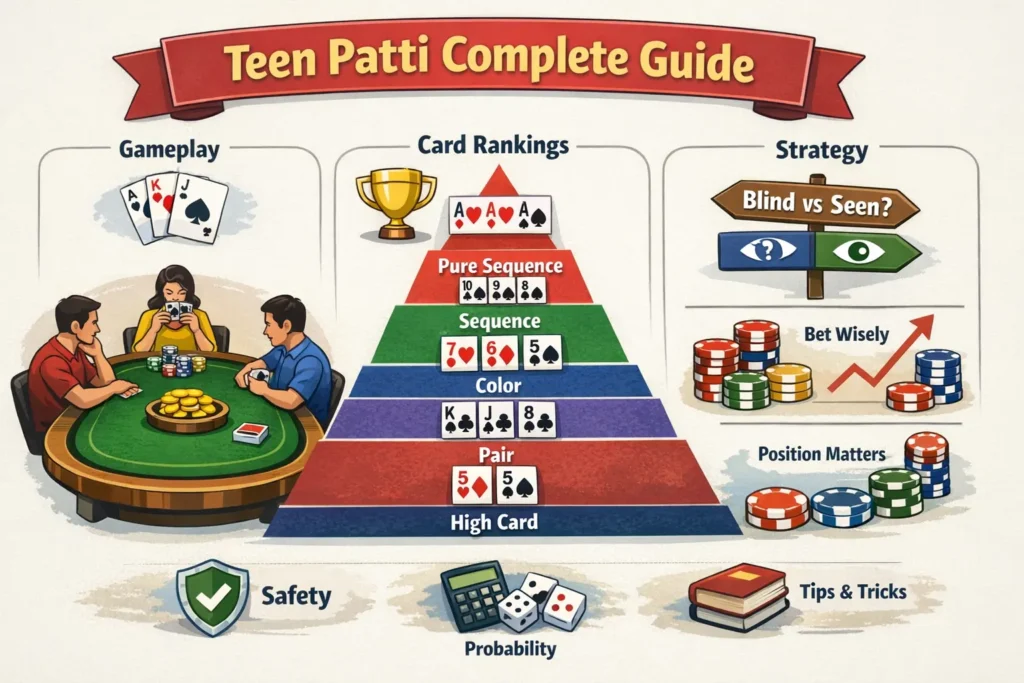
Teen Patti is one of the most popular three-card games played across India. Whether you are a beginner trying to understand the fundamentals or someone looking to improve decision-making skills, this Teen Patti complete guide covers everything from rules and card ranking to advanced strategy and gameplay.
To get the best experience and practice in real gameplay, it is recommended to use the latest Teen Patti APK version, which offers smooth performance, updated features, and better gameplay control.
Before joining any table, it is important to understand the complete Teen Patti rules properly so that you avoid confusion during betting rounds and comparison stages.
🎯 What You Will Learn in This Complete Guide
This guide will help you understand:
- Basic rules of Teen Patti
- Card ranking hierarchy
- Blind vs Seen mechanics
- Betting structure
- Strategic decision-making
- Common beginner mistakes
- Responsible and safe participation
If you are completely new, you can first explore the step-by-step gameplay process and then start playing using the latest Teen Patti APK for real experience.
This Teen Patti complete guide 2026 explains rules, ranking, gameplay structure, and how to get started quickly.
Play with the Official Teen Patti Master Hierarchy
Now that you know the teen patti highest card and ranking, it’s time to test your skills. Download the latest v19.2 build to get:
- Instant Welcome Bonus: Get up to ₹51 in credits to start playing.
- Verified Gameplay: Experience smooth animations and a stable multiplayer system.
- Secure Redemptions: Fast processing for all your in-game rewards.
Download Teen Patti Master APK Now
What Is Teen Patti?
Teen Patti is a traditional Indian card game played with a standard 52-card deck without jokers. Each player receives three face-down cards, and the objective is to form the strongest possible hand based on ranking hierarchy.
The game is usually played by 3 to 6 players and follows a structured betting sequence. Unlike poker, Teen Patti uses a different ranking order and includes blind play options that add psychological depth.
Understanding gameplay structure is essential before focusing on strategy.
Historical Background of Teen Patti
Teen Patti has roots in traditional Indian card culture and is often compared with three-card variations of poker. The game has evolved socially across different regions of India and is commonly played during festivals and gatherings.
According to publicly documented sources such as
👉 Teen Patti Wikipedia
Teen Patti is considered a simplified gambling card format derived from British card influences during the colonial period.
Understanding its background helps contextualize why rules and ranking structure differ slightly from poker.
Basic Gameplay Structure
Every Teen Patti round follows a fixed sequence:
Boot Amount → Card Distribution → Blind/Seen → Betting → Sideshow → Show → Winner
Boot Amount
Each player contributes a fixed minimum amount to create the starting pot.
Card Distribution
The dealer distributes three face-down cards to each player.
Blind or Seen
Players choose whether to:
- Play Blind (without seeing cards)
- Play Seen (after viewing cards)
Betting
Players take turns placing bets. They may:
- Call (match current bet)
- Raise (increase bet)
- Fold (exit round)
Sideshow
A seen player may request a private comparison with the previous seen player.
Show
When only two players remain, one may request a show to reveal cards and determine the winner.
For a detailed breakdown of each step including betting multiples and position logic, refer to the step-by-step Teen Patti gameplay flow explanation.
Teen Patti Card Ranking Hierarchy
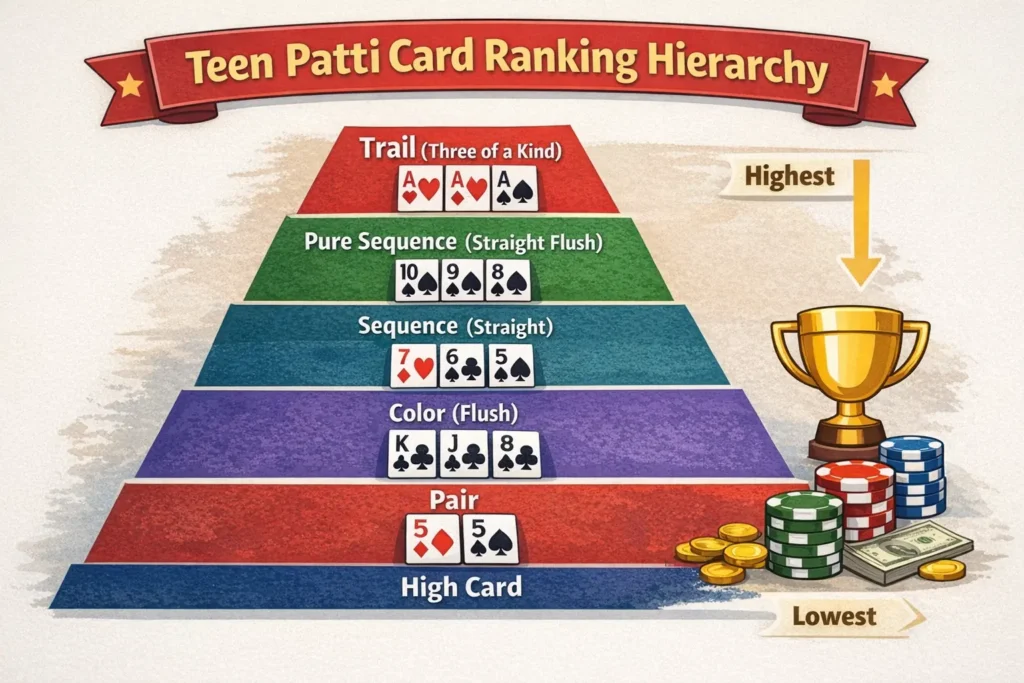
Winning depends on understanding hand strength. Below is the standard ranking from highest to lowest:
- Trail (Three of a Kind)
- Pure Sequence (Straight Flush)
- Sequence (Straight)
- Color (Flush)
- Pair
- High Card
Trail
Three cards of the same rank. Example: A-A-A.
Pure Sequence
Three consecutive cards of the same suit.
Sequence
Three consecutive cards, suit does not matter.
Color
Three cards of the same suit but not consecutive.
Pair
Two cards of the same rank.
High Card
Highest single card determines strength if no combination forms.
For full comparison rules including tie-breaking and kicker logic, review the complete card ranking comparison guide and detailed Teen Patti card ranking hierarchy explanation.
By following this Teen Patti complete guide, players can avoid confusion during betting rounds and improve overall clarity.
To simplify hand comparison visually, refer to the table below.
Teen Patti Hand Comparison Table
Below is a simplified comparison table to help beginners quickly understand hand strength and probability context.
| Hand Type | Strength Level | Rare or Common | Beats Which Hands |
|---|---|---|---|
| Trail (Three of a Kind) | Very High | Rare | All other hands |
| Pure Sequence | High | Rare | Sequence, Color, Pair |
| Sequence | Medium-High | Moderate | Color, Pair, High Card |
| Color | Medium | Moderate | Pair, High Card |
| Pair | Low-Medium | Common | High Card |
| High Card | Lowest | Very Common | None |
Blind vs Seen – Strategic Decision Making
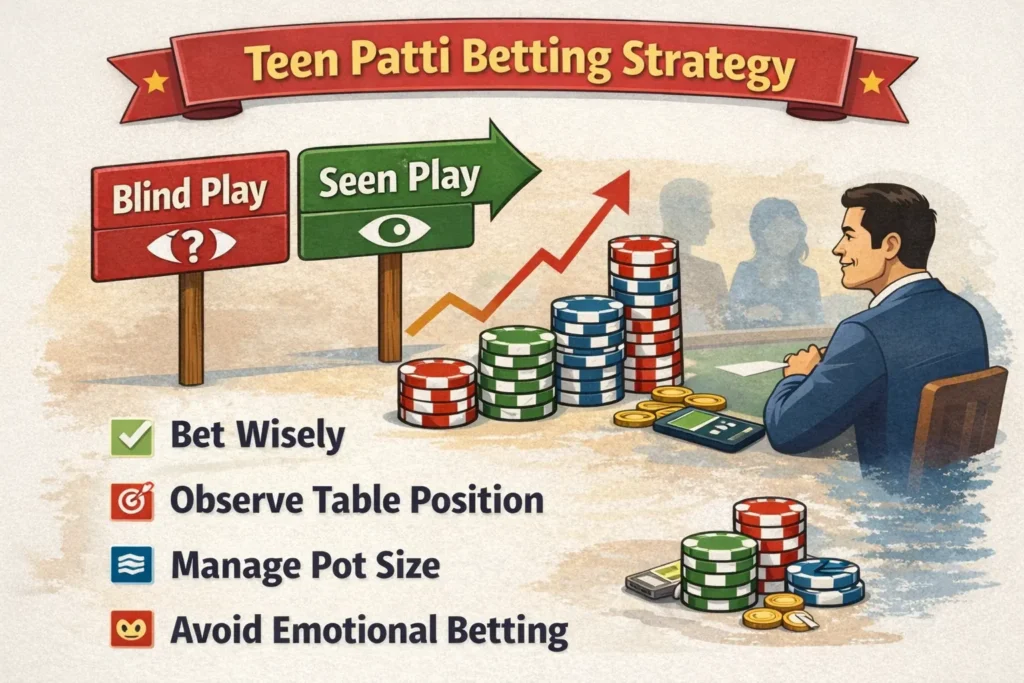
One of the most unique aspects of Teen Patti is the choice between blind and seen play.
Blind Play
- You do not look at your cards.
- Betting amount is typically lower initially.
- Adds psychological pressure.
- Involves calculated risk.
Seen Play
- You look at your cards before betting.
- Betting amount is usually double the blind stake.
- Allows informed decisions.
Blind play can build early pressure, while seen play provides strategic clarity. Understanding when to switch between them improves control and reduces impulsive losses.
For deeper understanding of betting structure, refer to the Teen Patti betting rules and rules overview.
Understanding Probability in Teen Patti
Teen Patti is not fully predictable, but probability awareness improves decision-making.
- Trail is rare.
- Pair appears more frequently.
- High card situations are common.
If betting becomes aggressively high early in a round, probability suggests strong hands are statistically rare. Smart players evaluate betting behavior rather than assuming strength blindly.
This Teen Patti complete guide also highlights the importance of probability awareness in long-term play.
Pot Control Strategy
Pot control means managing the size of the betting pool based on hand strength.
Common mistakes include:
- Over-raising with medium-strength hands.
- Escalating bets emotionally.
- Forcing show requests.
Controlled betting ensures long-term stability rather than short-term risk.
The strategy principles discussed in this Teen Patti complete guide focus on discipline rather than aggressive betting.
Table Position Awareness
Position affects decision-making:
- Early position: Limited information.
- Middle position: Moderate observation.
- Late position: More data about opponent behavior.
Late position players often make more informed decisions based on previous betting patterns.
Reading Opponents
Teen Patti includes psychological elements.
Observe:
- Who consistently plays blind?
- Who raises frequently?
- Who folds early?
- Who demands show often?
Behavior patterns reveal confidence levels and risk appetite.
Why This Teen Patti Complete Guide Is Important for Beginners
To improve gameplay:
- Do not overplay weak hands.
- Avoid emotional betting.
- Fold when necessary.
- Manage bankroll carefully.
- Study ranking structure thoroughly.
Reading the practical Teen Patti play guide helps beginners apply theory into real scenarios.
Common Beginner Mistakes
Many players:
- Confuse Sequence and Color.
- Misjudge Pair strength.
- Continue betting despite weak cards.
- Ignore betting discipline.
- Misunderstand show timing.
These errors often happen due to incomplete knowledge of the detailed Teen Patti ranking logic.
Special Case: A-2-3 Sequence
In most versions, A-2-3 is treated as the lowest sequence. However, Q-K-A ranks higher. Understanding this avoids incorrect comparison during a show.
Teen Patti Variations
Popular variations include:
Muflis
Lowest hand wins instead of highest.
AK47
Cards A, K, 4, and 7 act as jokers.
Joker Variation
Random card becomes wildcard.
Lowest Joker
Lowest card in deck becomes joker.
Each variation modifies strategic approach.
Bankroll Management
Responsible players:
- Set session limits.
- Avoid chasing losses.
- Protect small gains.
- Play within comfort limits.
Discipline prevents impulsive decisions.
Digital Version Overview
Modern mobile versions allow:
- Multiplayer tables.
- Smooth card animations.
- Updated builds.
- Device compatibility improvements.
If you are looking for the current build, you can access the official Teen Patti Master APK download page.
If your device requires an older release, consider the download previous stable version option.
Safety and Responsible Play
Teen Patti is traditionally a social game. Digital formats may be subject to regional regulations.
Before installing any file:
- Verify download source.
- Avoid modified builds.
- Scan APK files.
- Review permissions carefully.
For more clarity, review the Teen Patti safety and responsible play information and important safety guidelines before download.
Responsible participation is an important part of this Teen Patti complete guide, especially for digital formats.
Frequently Asked Questions
What is the highest hand in Teen Patti?
Trail (Three of a Kind) is the highest ranking hand.
Is A-2-3 valid?
Yes, it is generally the lowest sequence.
Is Teen Patti similar to poker?
It shares similarities but follows different ranking and betting structure.
Can I play Teen Patti online?
Yes, mobile versions allow multiplayer gameplay.
For more queries, check the Teen Patti Master FAQ section.
Before moving to advanced gameplay, review this Teen Patti complete guide thoroughly to build strong fundamentals.
Advanced Decision-Making Framework in Teen Patti
Serious players sirf cards pe focus nahi karte. Wo decision layers pe kaam karte hain.
Teen Patti me har decision 3 cheezon pe depend karta hai:
- Hand strength
- Opponent behavior
- Pot size
Agar hand medium hai lekin opponent defensive play kar raha hai, to aggressive raise unnecessary risk ho sakta hai.
Decision-making structured hona chahiye, emotional nahi.
Risk vs Reward Analysis
Har bet ka ek risk-reward ratio hota hai.
Example:
Agar pot small hai aur bet large ho raha hai, to risk disproportionate ho jata hai.
Smart players evaluate:
- Kitna invest kar rahe hain?
- Kitna jeet sakte hain?
- Probability kya suggest karti hai?
Yeh mindset long-term consistency deta hai.
Psychological Pressure and Table Control
Teen Patti psychological game hai.
Blind players often table control karte hain kyunki:
- Opponents unsure hote hain unki hand strength ke baare me
- Aggressive blind play confusion create karta hai
Lekin overuse karne se predictability badh jati hai.
Balance important hai.
Timing of Show – Strategic Importance
Show demand karna bhi strategy hai.
Agar opponent:
- Nervous lag raha ho
- Frequent raise ke baad sudden slow ho gaya ho
- Bet pattern inconsistent ho
Tab show demand beneficial ho sakta hai.
Lekin weak hand ke saath show demand karna unnecessary loss la sakta hai.
Multi-Player Dynamics
Teen Patti 2-player game nahi hai.
3+ players hone par dynamics change hote hain:
- Probability shift hoti hai
- Pot size fast increase hota hai
- Bluff risk badhta hai
Zyada players hone par conservative strategy useful hoti hai.
When to Switch from Blind to Seen
Blind start karna pressure build karta hai.
Lekin:
- Agar pot large ho raha hai
- Players aggressive hain
- Risk increase ho raha hai
Tab seen shift karna practical hota hai.
Switch timing important factor hai.
Long-Term Play vs Short-Term Luck
Teen Patti short term me luck heavy lag sakta hai.
Lekin long-term me:
- Discipline
- Probability awareness
- Controlled betting
Zyada impact dalte hain.
Professional mindset hamesha long-term result pe focus karta hai.
Device Compatibility and Performance Awareness
Digital version me:
- App optimization
- Android version compatibility
- Storage availability
- Stable network connection
Performance affect karte hain.
Installation se pehle ensure karein:
- Device minimum Android requirement meet kare
- Enough storage space available ho
- Stable internet ho
For updated build information, refer to the official Download Teen Patti Master Latest Version page.
Data Privacy and Security Awareness
Digital card apps install karte waqt:
- Unknown sources carefully enable karein
- App permissions review karein
- Sensitive information share karne se bachein
Responsible download practices follow karna zaroori hai.
Detailed awareness ke liye review karein the important safety guidelines before download section.
Skill Improvement Roadmap
Agar beginner ho, ye structured learning follow karo:
Step 1 – Learn basic rules
Step 2 – Understand ranking hierarchy
Step 3 – Observe 10–15 rounds without aggression
Step 4 – Apply controlled betting
Step 5 – Practice blind vs seen timing
Gradual improvement sustainable hota hai.
Difference Between Casual and Informed Play
Casual play:
- Emotion-driven
- Random betting
- No ranking clarity
Informed play:
- Structured decisions
- Ranking awareness
- Pot control
- Risk evaluation
Difference long-term result me clearly visible hota hai.
Advanced Gameplay Scenarios and Practical Examples
Understanding theory is important, but real improvement happens when you visualize actual gameplay situations. Below are practical round-based scenarios that help clarify decision-making.
Scenario 1: Medium Strength Hand in Early Position
Imagine you are in early position and receive a Pair (for example, 9-9-4). Two players after you start betting aggressively.
In this situation:
- Pair is not a very strong hand.
- Early position means you have limited information.
- Aggressive betting from multiple players increases risk.
Instead of raising emotionally, a controlled call or fold may be the smarter decision depending on pot size.
This example highlights why understanding the Teen Patti card ranking hierarchy is not enough; betting context matters equally.
Scenario 2: Playing Blind with Table Pressure
You start the round blind. Pot is small. You raise slightly to build pressure.
Two players fold. One seen player calls.
Now you have to decide:
- Continue blind and maintain pressure?
- Switch to seen?
- Fold if pot grows too large?
Blind play works best when used strategically, not continuously. Smart switching between blind and seen is often more effective than aggressive blind-only play.
For structured understanding of blind mechanics, review the Teen Patti betting rules and rules overview carefully.
Scenario 3: Late Position Advantage
You are last to act in the betting order. Three players before you have called without raising.
This usually indicates:
- Medium hands
- No strong trail or pure sequence
- Pot is still manageable
Late position gives you the advantage of information. Even a decent sequence or strong color can justify a controlled raise here.
Position awareness often separates disciplined players from impulsive ones.
Strategic Comparison Techniques
When a show situation arises, comparison logic becomes critical.
Pair vs Pair
Higher pair wins.
If both players have same pair, third card (kicker) decides.
Example:
10-10-8 beats 10-10-5.
Color vs Color
Highest card compared first.
If equal, second highest compared.
Understanding these tie-break rules reduces mistakes during final show decisions.
Emotional Control and Decision Discipline
Teen Patti is emotionally reactive if not handled properly.
Common emotional triggers:
- Losing consecutive rounds
- Large pot build-up
- Opponent aggressive behavior
- Peer pressure
Professional mindset includes:
- Accepting short-term losses
- Avoiding revenge betting
- Taking breaks when required
- Maintaining session discipline
Emotion-driven play often leads to unnecessary risk.
Long-Term Skill Development
Skill improvement in Teen Patti is gradual.
Suggested learning progression:
- Master rules and ranking.
- Observe multiple rounds without aggressive betting.
- Identify betting patterns.
- Practice disciplined folding.
- Improve blind vs seen timing.
Reading the complete Teen Patti rules explained article again after practical play often clarifies mistakes.
Table Awareness in Multi-Player Rounds
When 4–6 players are active:
- Probability of strong hands decreases.
- Bluff risk increases.
- Pot size grows faster.
In such rounds, conservative strategy is safer than aggressive early raises.
Understanding Pot Psychology
Large pots create psychological pressure.
Players often:
- Overestimate their hands.
- Fear folding after investing.
- Demand show prematurely.
Smart players detach emotionally from invested amount and focus on hand strength and probability.
Responsible Participation Framework
Teen Patti should be treated as entertainment.
Key principles:
- Avoid unrealistic earning expectations.
- Never rely on short-term wins.
- Follow local legal guidelines.
- Protect personal information.
- Avoid downloading from unknown sources.
Before installing any digital version, review the important safety guidelines before download carefully.
Digital Version Awareness and Updates
Mobile versions may include:
- Performance updates
- Stability improvements
- Compatibility fixes
- Minor feature adjustments
Using outdated builds may cause:
- Installation errors
- Login problems
- Performance instability
To access the latest compatible build, visit the official Teen Patti Master APK download page.
If device compatibility is an issue, you may consider the download previous stable version page instead.
Knowledge vs Random Play
There is a clear difference between:
Casual Play:
- Random decisions
- Emotional reactions
- Limited ranking clarity
Informed Play:
- Structured betting
- Position awareness
- Controlled aggression
- Ranking confidence
Players who invest time in understanding the Teen Patti card ranking hierarchy and structured gameplay tend to make better decisions.
Key Takeaways from This Teen Patti Complete Guide
- Teen Patti follows a structured betting flow and ranking hierarchy.
- Trail (Three of a Kind) is the strongest hand in standard gameplay.
- Blind and Seen play require different strategic approaches.
- Position awareness improves betting decisions.
- Probability understanding reduces emotional mistakes.
- Responsible participation is essential in digital formats.
- This Teen Patti complete guide builds strong foundational clarity for beginners.
Final Extended Conclusion
Teen Patti is not just a three-card game; it is a combination of:
- Probability awareness
- Psychological observation
- Risk management
- Emotional discipline
- Strategic timing
Understanding rules, ranking, and betting logic builds confidence and reduces avoidable mistakes.
Before participating in any digital version, it is recommended to review the how to play Teen Patti step by step guide and apply responsible usage principles.
Knowledge-driven participation ensures better clarity, controlled risk, and a structured gameplay experience. This Teen Patti complete guide helps beginners build strong fundamentals.